
A Complete Guide for Foreign Investors Starting a Business in Thailand
Thailand is one of Southeast Asia’s most attractive investment destinations, offering strong infrastructure, a skilled workforce, and strategic access to ASEAN markets. However, foreign investors who wish to establish a business in Thailand must understand the legal framework governing foreign participation, particularly Foreign Business Law Thailand and the Foreign Business Act B.E. 2542 (1999) (FBA).
This law defines the scope, restrictions, and conditions under which foreign nationals may operate businesses in Thailand.
This article explains the key legal considerations every foreign investor should know before starting a business in Thailand.
Lists of Content
How Much Can Foreigners Own in a Thai Company?
Is a 51% Thai Shareholder Required?
Which Businesses Allow 100% Foreign Ownership in Thailand?
What Does the Foreign Business Act (FBA) Restrict?
What Is a Foreign Business License (FBL)?
Can BOI Allow 100% Foreign Ownership?
Risks of Using Nominee Shareholders
How Much Can Foreigners Own in a Thai Company?
One of the most frequently asked questions is: What percentage of a Thai company can foreigners own?
There is no universal rule limiting foreign ownership to 49%. The allowable shareholding depends on the type of business and legal structure.
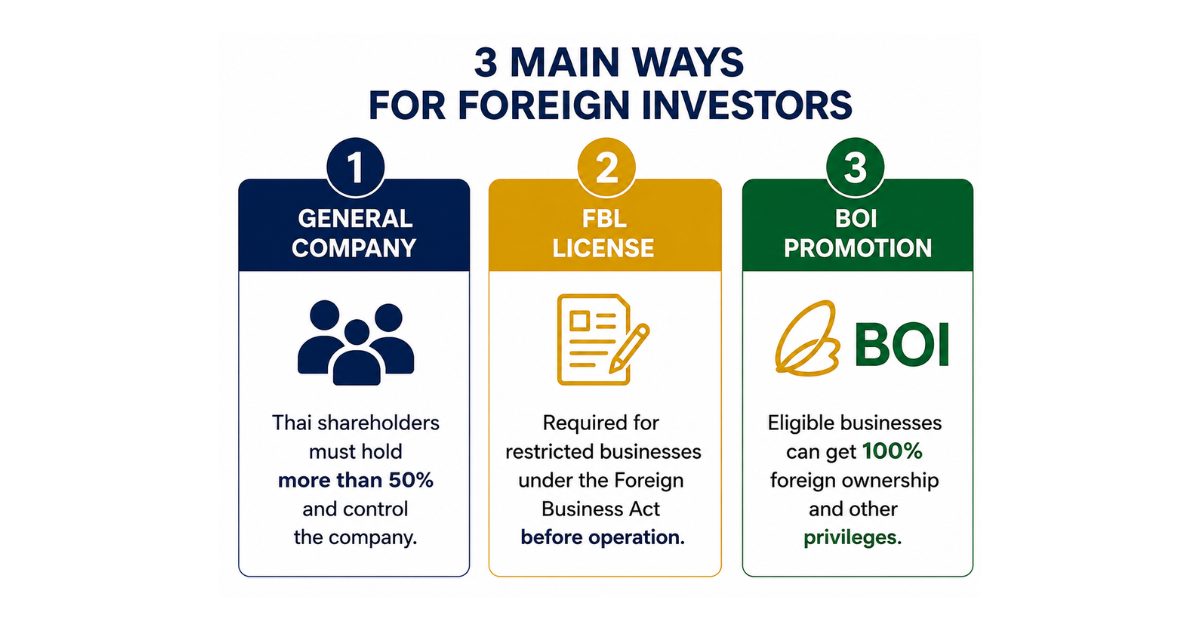
Generally, there are three main scenarios:
1. Thai Company Structure
If Thai nationals hold more than 50% of shares and maintain control of the company, it is generally considered a Thai company. However, authorities may investigate the actual control structure if there is suspicion of nominee arrangements.
2. Foreign Company Structure
If foreigners hold 50% or more of shares, or if the company falls under the legal definition of a “foreign entity” under the FBA, the business may be subject to restrictions depending on its activities.
3. BOI-Promoted Company
Companies promoted by the Thailand Board of Investment (BOI) may be granted permission for 100% foreign ownership, depending on the approved business category.
Is a 51% Thai Shareholder Required?
A common misconception is that all Thai companies must have 51% Thai ownership. This is not always true.
In reality:
- Some businesses allow 100% foreign ownership
- Some require a Foreign Business License (FBL)
- Some qualify for BOI promotion
- Some fall under international treaties or special agreements
Therefore, before setting up a company, investors must determine whether their business is restricted under the Foreign Business Act Thailand and which legal pathway applies.
Which Businesses Allow 100% Foreign Ownership in Thailand?
Foreign investors may legally own 100% of a Thai company in several cases, such as:
- BOI-promoted businesses
- Businesses not listed under restricted categories in the FBA
- Companies granted a Foreign Business License (FBL)
- Businesses covered under international treaties (depending on nationality and conditions)
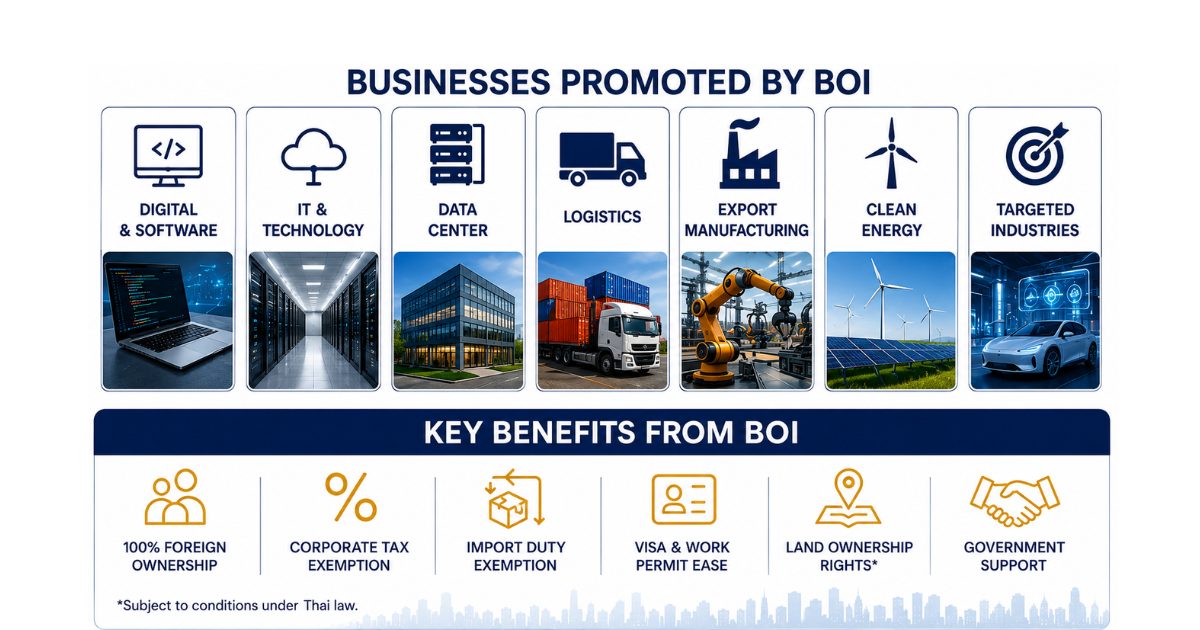
Common BOI-promoted industries include:
- Software development
- Information technology services
- Data centers
- Selected logistics operations
- Export-oriented manufacturing
- Renewable energy
- Targeted high-tech industries
Each approval depends on investment conditions and BOI evaluation.
What Does the Foreign Business Act (FBA) Restrict?
The Foreign Business Act Thailand is the primary law regulating foreign participation in business activities. It classifies restricted businesses into three categories:
List 1: Strictly Prohibited Businesses
These include activities related to national security, culture, and certain natural resources. Foreigners are strictly prohibited from operating these businesses.
List 2: Restricted Businesses Requiring Special Permission
These involve national security, arts, culture, or natural resources. Foreigners may operate them only with government approval.
List 3: Restricted Service and Commercial Businesses
These include sectors where Thai businesses are not yet fully competitive, such as certain service industries, wholesale/retail trade, and professional services. Foreigners must obtain a license before operating.
Investors should carefully identify which list their business falls under to ensure proper legal planning.
What Is a Foreign Business License (FBL)?
A Foreign Business License (FBL) is an official permit allowing foreigners to operate restricted businesses under the Foreign Business Act Thailand.
Approval is based on several factors, including:
- Economic benefit to Thailand
- Technology transfer
- Employment of Thai nationals
- Impact on local businesses
- Financial strength and business plan
A well-prepared application with strong supporting documentation significantly increases approval chances.
Can BOI Allow 100% Foreign Ownership?
Yes, in many cases.
The Thailand Board of Investment (BOI) offers incentives to promote industries beneficial to the country’s economic development.
Key benefits may include:
- 100% foreign ownership
- Visa and work permit facilitation
- Corporate tax incentives
- Import duty exemptions on machinery and materials
- Land ownership rights for business use (under specific conditions)
However, not all businesses qualify. Investors should review BOI criteria or consult legal experts before applying.
Risks of Using Nominee Shareholders
A nominee shareholder refers to a person who holds shares on behalf of a foreign investor without real investment or control.
This practice may be considered an attempt to circumvent the Foreign Business Law Thailand and can lead to serious legal consequences if discovered, including:
- Revocation of business rights
- Criminal prosecution
- Administrative penalties
- Business disruption and reputational damage
Therefore, investors should avoid illegal nominee structures and instead use lawful options such as BOI promotion or obtaining a Foreign Business License.
Why You Should Consult a Lawyer Before Setting Up a Company
Starting a business in Thailand involves multiple legal frameworks, including corporate law, tax law, labor law, and the Foreign Business Act Thailand.
Consulting a legal professional helps investors:
- Choose the correct business structure
- Determine FBA restrictions
- Plan compliant shareholding structures
- Apply for necessary licenses
- Reduce long-term legal risks
- Build credibility with partners and authorities
Conclusion
Thailand remains a highly attractive destination for foreign investment. However, success depends on a clear understanding of Foreign Business Law Thailand, particularly the Foreign Business Act (FBA), which governs foreign ownership and business activities.
Instead of using high-risk structures such as nominee shareholders, investors should pursue legal pathways such as:
- Foreign Business License (FBL)
- BOI investment promotion
Proper legal planning from the beginning ensures compliance, reduces risk, and creates a strong foundation for long-term business success in Thailand.